The Southern Family Gathering
A family gathering rarely stays in one room or one mood. It moves from the yard to the kitchen, from the carefully arranged portrait to the joke that makes everyone forget to pose.
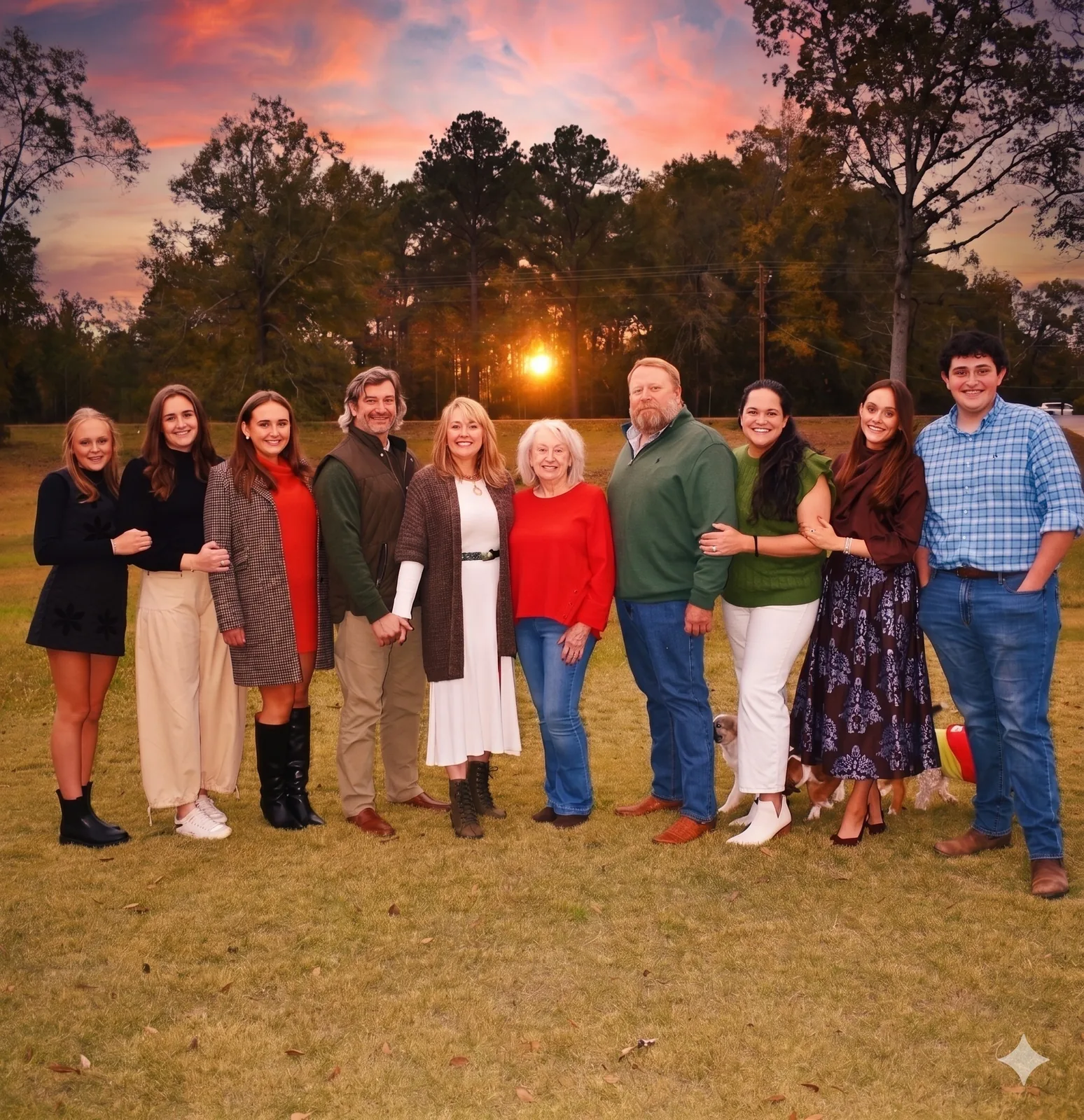
Everyone together before the light disappears
The opening photograph catches a large group arranged across a grassy yard while the sun sinks behind tall trees. Pink and orange clouds fill the sky, giving the portrait a glow no indoor light could reproduce. Brenda stands near the center in bright red, surrounded by adults and younger family members whose clothing carries greens, browns, white and blue across the frame.
A group picture of this size never happens entirely by accident. Someone notices the sky. Someone calls everybody outside. People who were talking in separate rooms are gathered, and the tallest person is asked to move toward the back. A dog wanders near the line, bringing the welcome unpredictability of real family life.
The result is more than a record of faces. The sunset, open yard and slight variations in posture preserve the atmosphere of a particular gathering without requiring us to invent its date. Everyone has paused long enough to share one horizon. Within minutes, the light will change and the group will break apart again, which makes the photograph feel both abundant and fleeting.
The meal is only one part of the gathering
Food may bring everyone to the same address, but a family gathering expands beyond the table. People arrive carrying dishes and bags. Coats collect on a bed. Younger relatives drift toward the yard while adults exchange news near the kitchen. The cook answers questions without stopping work, and the house develops its own cheerful traffic pattern.
A generous meal supports this movement. Dishes that can wait, travel and serve many people reduce the need for perfect timing. A casserole rests warmly. Bread passes easily. A large dessert can be sliced after the main plates are cleared. The menu works best when it lets the day breathe.
What people remember is often not the order of courses, but the freedom of returning to the conversation. Someone stands for another helping and comes back with a story. Children finish quickly and disappear outdoors. Coffee extends the visit after everyone insists they could not eat another bite.
The younger generation makes its own photograph
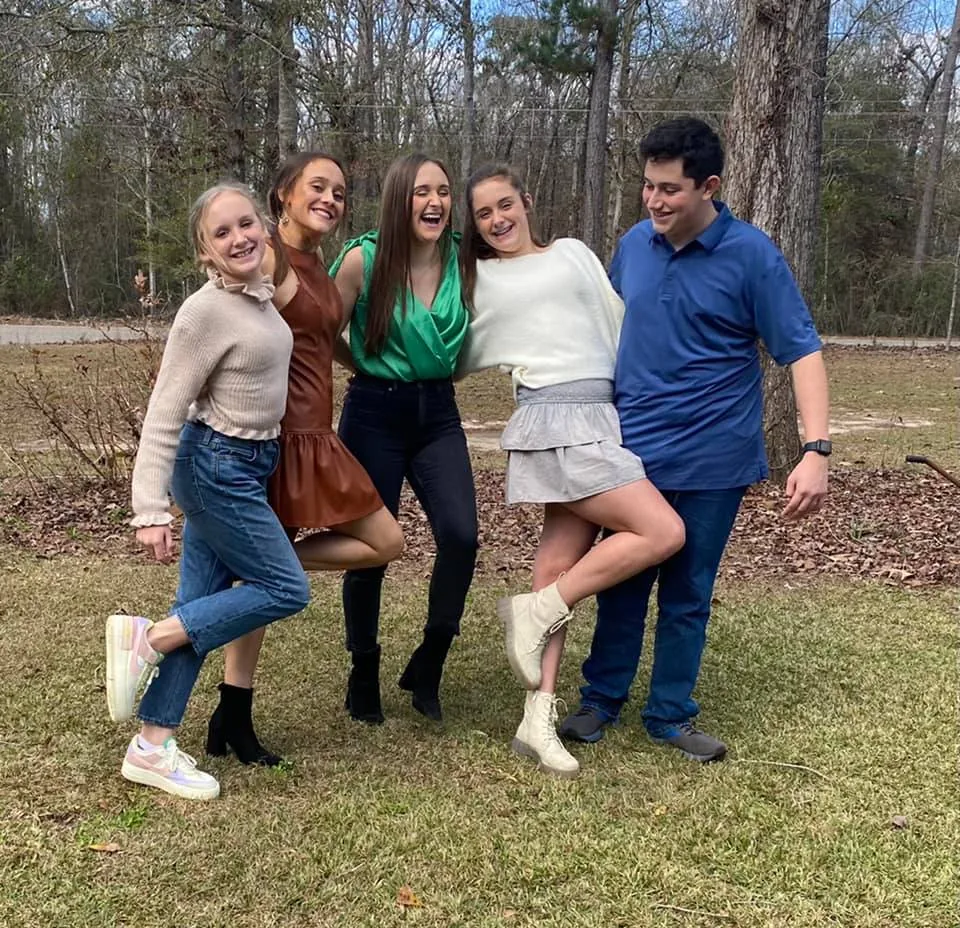
The next image belongs to five younger family members standing together in the yard. Instead of holding a careful line, they lean, lift their feet and laugh. Two figures in the center appear caught mid-joke, while the young man at the edge looks toward the others rather than directly at the camera.
This is what happens when a group portrait is allowed to loosen. Individual personalities return. The wooded background and winter ground keep the setting simple, so the movement of the people becomes the subject. Their picture feels like a memory they made together rather than an assignment from the adults.
Every multigenerational gathering contains smaller circles like this one. Cousins, siblings and friends close in age share references and stories that belong partly to them. They move between the larger family and their own conversations, continuing old bonds while creating traditions the older generation may only glimpse.
From formal clothes to comfortable ones
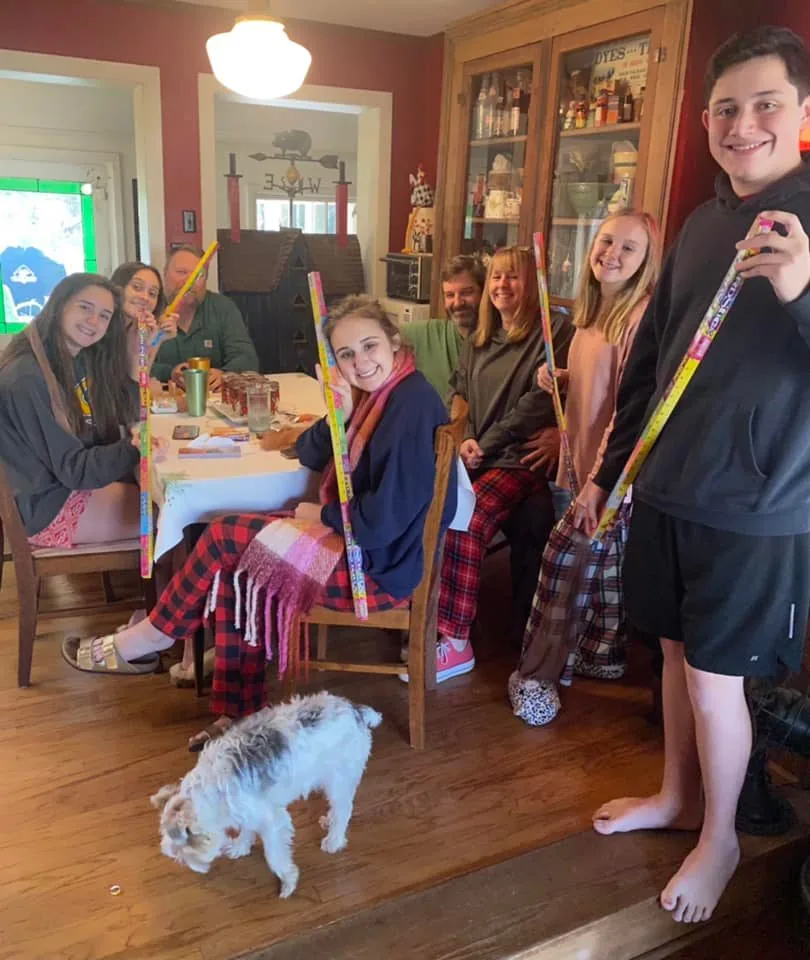
The kitchen photograph changes the tone again. Several people gather around a long table in relaxed clothes, many wearing plaid or pajama-like patterns. Brightly colored, extra-long treats or gifts are held upright, turning the room into a playful forest of color. A small dog crosses the floor as if no photograph is taking place at all.
This image preserves the part of a family visit that formal portraits miss: the hour when shoes come off, chairs shift and everyone settles into the house. Elegance gives way to comfort. The table is no longer arranged for display; it has become a base for opening, eating, talking and laughing.
The background is full of familiar domestic details—wooden cabinets, collected dishes, a hanging light and the doorway into another room. The setting makes clear that the gathering is happening inside a lived-in home. People do not need to protect the space from themselves. They belong there.
A room large enough because people make it so
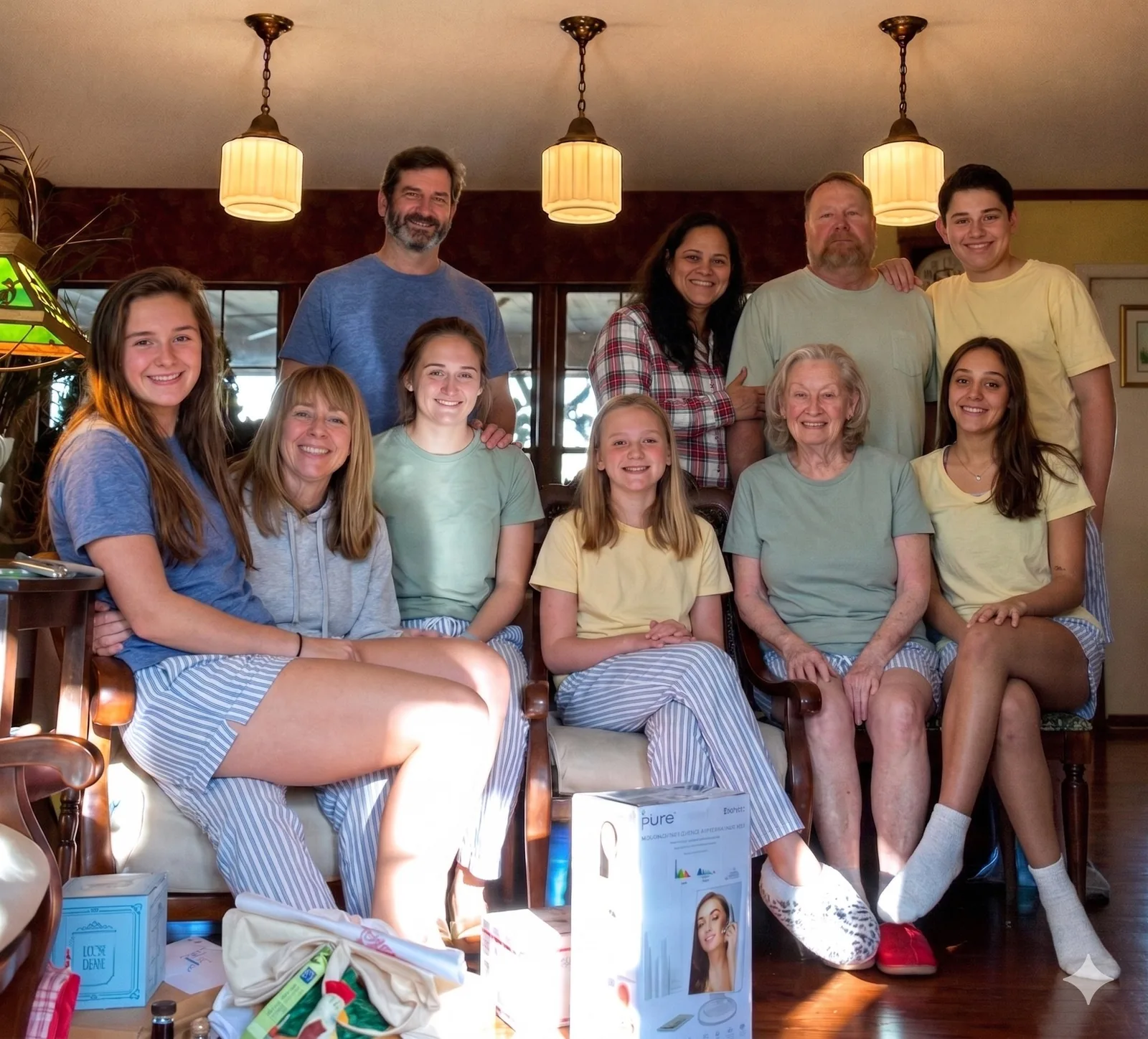
The final group photograph brings many generations together indoors. Some people stand while others sit in wooden chairs. Soft green, yellow and blue repeat across shirts and striped pants, giving the arrangement an informal sense of coordination. Boxes and household objects remain visible at the bottom of the frame, evidence that the room was adapted to the occasion instead of emptied for it.
A crowded family photograph has its own visual honesty. Knees overlap, shoulders touch and not everyone has equal space. The composition works because the people are willing to adjust. That same flexibility makes a gathering possible: a chair is carried in, a plate is shared, and one more person fits because belonging matters more than symmetry.
Brenda sits among the younger faces rather than apart from them. The image becomes a map of continuity, showing how different ages can occupy one room and one moment. Years later, viewers may study the smallest details—who sat beside whom, what was on the floor or how the sunlight crossed the chairs—and find memories returning.
The best gatherings have several speeds
These four photographs show why a family day cannot be summarized by a single image. The sunset portrait is expansive and composed. The younger group is energetic. The kitchen scene is playful and relaxed. The indoor portrait is crowded, warm and generational.
A good gathering needs all of those speeds. There is time for preparation and time for spontaneity, time to sit at the table and time to wander outside. Some relatives talk loudly in a group; others connect during a quiet task in the kitchen. The day succeeds when people can move between those rhythms without feeling rushed.
Food holds the middle
Although the photographs focus on people, food remains the invisible structure connecting them. It gives everyone a reason to arrive around the same time and creates natural pauses in the day. Preparing, serving and cleaning become shared activities through which conversation continues.
Family recipes are particularly suited to such gatherings because they contain memory as well as flavor. A familiar side dish may recall someone who once made it. A dessert prompts comparison with last year’s version. Younger cooks learn where the serving bowls are kept and how much food “enough” really means when the whole family comes.
The table also gives generations equal ground. Everyone may have a different daily life, but all can pass a bowl, compliment a dish or ask for the recipe. Food translates affection into something immediately useful.
Take the photograph before everyone leaves
Near the end of a gathering, there is always a temptation to postpone the group picture. Someone is washing dishes, another person has changed clothes and the youngest are difficult to collect. Yet the imperfect photograph taken now will be more valuable than the perfect one that never happens.
Let the boxes stay in the foreground. Let the dog wander through. Let people laugh instead of looking in the same direction. These details restore the day whenever the image is opened again.
A Southern family gathering is not defined by flawless coordination. It is defined by return—people coming back to the house, the table and one another. The photographs preserve that return in four different ways, and together they say what hospitality has always meant: there was room, there was food and you were wanted here.