Two Days Together as a Family
When a family visit stretches beyond one meal, the kitchen becomes a place to return to—first for the work, then for the tasting, and always for another conversation.
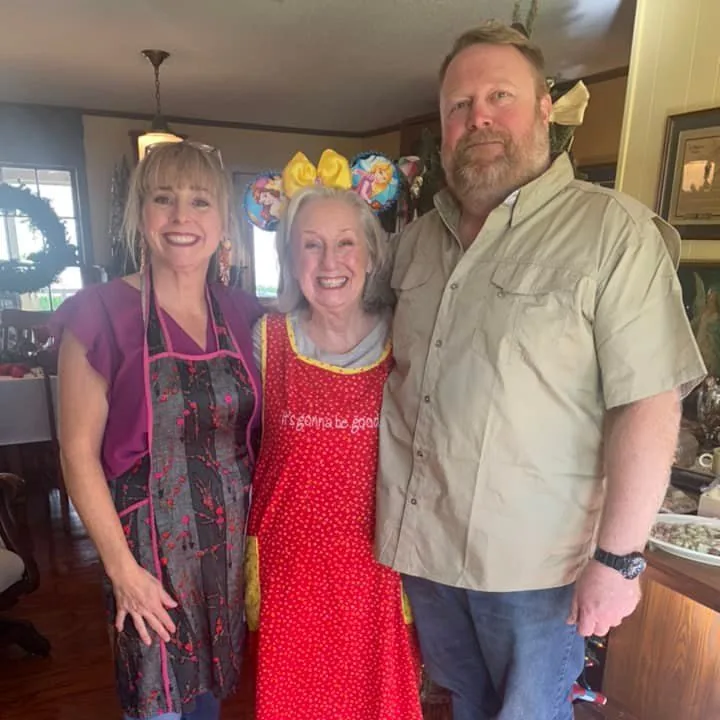
A visit finds its center in the kitchen
The opening photograph introduces three people standing close in a warm home kitchen. Two women wear aprons, while Brenda’s bright red apron and oversized, colorful headband give the portrait an unmistakably playful mood. A tall man stands beside them in a practical button-front shirt. All three have paused among counters, cabinets and serving dishes to mark the occasion.
Nothing about the room suggests that cooking is separate from the visit. The kitchen is both workplace and gathering space. Food waits at the edge of the frame, yet the people remain the subject. Their different clothing tells a small story of participation: some have been directly involved in preparation, while another may have arrived from a different task and stepped into the picture.
This is how extended family time often unfolds. People do not sit in one arranged group from arrival to departure. They move through rooms, trade responsibilities and join the activity at different points. The kitchen becomes a dependable center because everybody eventually needs something from it—and usually finds someone worth talking to there.
More time allows the gathering to relax
A short visit can feel scheduled. There is a meal, a round of conversation and the awareness that someone will soon need to leave. When time together stretches across a longer stay, the atmosphere changes. People see one another before the table is set and after the dishes are cleared.
Those in-between hours reveal family life more honestly than a formal event alone. Someone makes coffee while still dressed comfortably. Another person opens the refrigerator and asks what needs using. Plans for the next meal begin almost casually, shaped by leftovers, appetite and who is willing to help.
The phrase “two days together” suggests this broader rhythm, but the photographs do not verify a precise timetable. What they clearly preserve is a visit with several stages: a posed group in the kitchen, younger hands at work and a finished batch waiting to be shared.
The younger cook steps forward
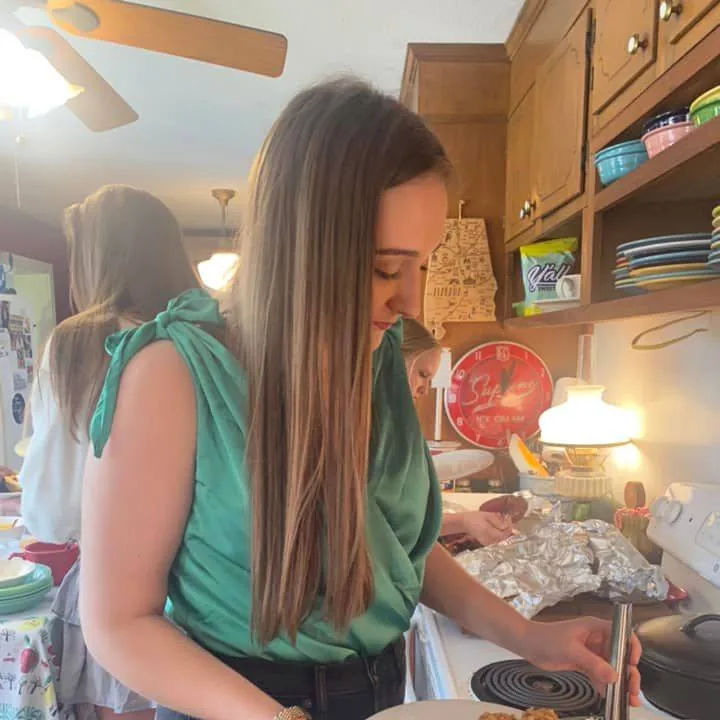
The second photograph moves closer to the work. A young woman in a green top stands at the stove, looking down with concentration as she handles food near the cooking surface. Other young people are visible behind her, working along the same counter. Foil, bowls, plates and colorful dishes show that preparation is active and shared.
This is a more valuable family photograph than a perfectly cleared kitchen would have been. It preserves competence developing in real time. The young cook is not merely watching an older generation perform a recipe; she has taken a place in the process.
Cooking traditions survive through exactly this shift. A learner begins with a contained task, asks questions and discovers that written instructions cannot answer everything. Heat must be judged. Texture must be recognized. Timing changes with the size of each piece and the behavior of the stove.
Teaching without taking over
Experienced cooks often know what to do so quickly that slowing down can be difficult. Teaching requires them to translate instinct into language: what does “hot enough” look like, how should the coating feel and when should food be turned?
The learner, meanwhile, needs room to make decisions. If an older hand corrects every motion immediately, the task never becomes her own. Good kitchen teaching stays close enough for safety but far enough away for confidence to grow.
Family visits provide natural opportunities for this kind of learning because the outcome has a real audience. The food is not a practice exercise that will be forgotten. It will be placed on a platter, carried to the table and eaten by people whose opinions matter.
A finished batch tells us the work succeeded
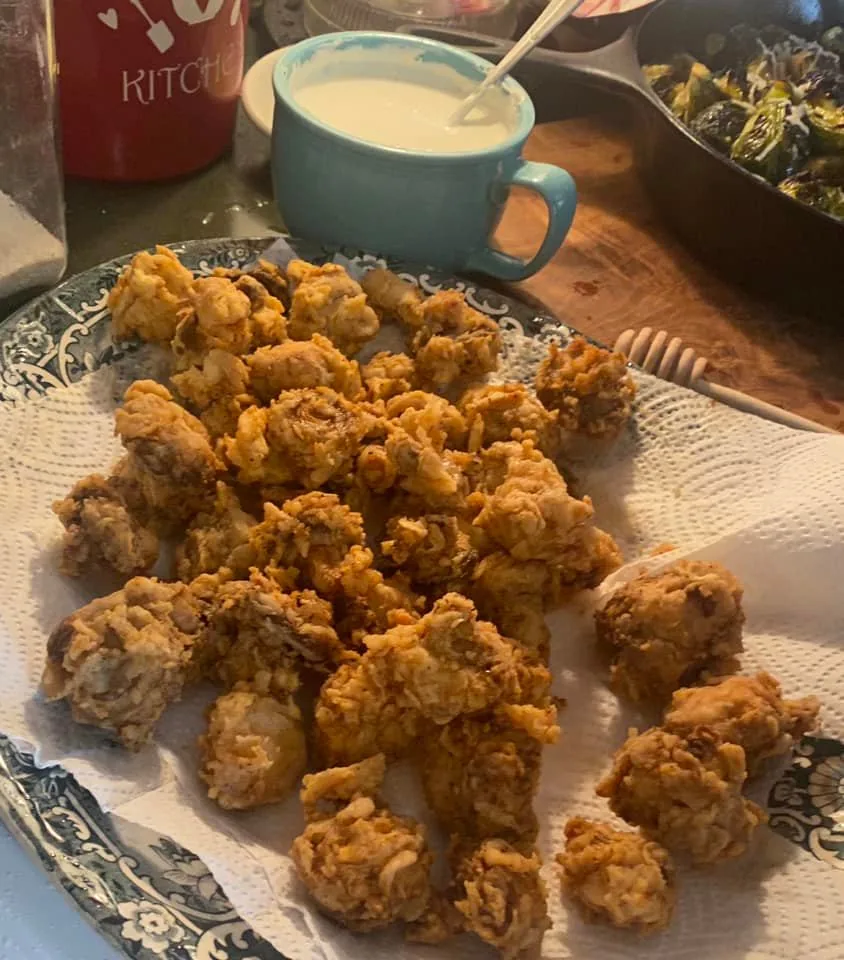
The last image turns fully toward the food. Golden, irregular bite-size pieces cover a large patterned platter lined with paper. A blue cup holds a pale sauce with a spoon, while a dark skillet of roasted green vegetables sits nearby. The counter bears the pleasant crowding of a meal approaching readiness.
The exact main ingredient is not certain from the photograph, so the honest description remains broad. What is clear is the cooking method’s result: crisp, textured coating, pieces small enough to share and a batch large enough for several people to taste.
Irregularity makes the platter more appealing. Each piece shows that it was handled individually rather than formed by a machine. Some are darker, some lighter, and no two shapes match exactly. Home cooking carries the hand of the cook in these variations.
The best tasting happens near the counter
Food like this rarely reaches the table completely untouched. Someone walks past, asks whether it is ready and takes a small piece after being warned that it is still hot. Another person tests the sauce. The cook tastes for seasoning while claiming the bite is only quality control.
These unofficial moments are part of the gathering. They reward the people doing the work and create anticipation for the meal. A kitchen full of family naturally becomes both production line and tasting room.
The platter’s placement beside the sauce and vegetables also suggests how separate tasks become one menu. Different people can work on different components, then watch them meet on the same counter. Coordination makes a larger meal possible without requiring one person to control every pan.
Shared cooking changes the conversation
Side-by-side work invites a different kind of talk than sitting face-to-face. Hands remain occupied, pauses feel natural and serious subjects can arise without demanding constant eye contact. Stories are told while vegetables are trimmed or batches are turned.
Older relatives may recall how a recipe was made in another kitchen. Younger ones bring new preferences or techniques. Small disagreements become part of the fun as long as the goal remains shared: make something good enough to pass around.
By the time the food is ready, the conversation has seasoned the memory. Later, people may recall not only the flavor, but who stood at the stove and what everyone laughed about while waiting.
Let the visit have ordinary moments
An extended gathering does not need continuous entertainment. People can read, rest, walk outside or help themselves to leftovers. Comfortable silence is often a sign that guests no longer feel like guests.
The kitchen benefits from this slower pace. There is time to clean between meals, reconsider plans and let somebody else lead the next round of cooking. The household does not have to produce a formal occasion every few hours.
Ordinary moments also make the photographs more valuable. An apron worn for fun, a crowded counter and a concentrated face at the stove reveal the character of the visit more clearly than a series of identical posed groups.
What three photographs can preserve
The first image gives us welcome and playfulness. The second gives us shared work and learning. The third gives us the tangible reward—a platter ready for many hands. Together they create a complete kitchen narrative without requiring an invented schedule.
Time with family becomes meaningful through accumulation. No single conversation or dish must carry the entire visit. The hours fill with small acts: standing close for a picture, making room at the stove, tasting a fresh batch and returning later to the kitchen for one more bite.
That may be the greatest gift of having more than a hurried meal together. There is enough time for people to stop performing the occasion and begin living inside it. The food feeds the gathering, but the shared work gives everyone a part of the story.